
A print on demand setup review should begin before a file reaches a printer. Your manuscript may be finished, your cover may look professional, and your launch date may be close, but the publishing details behind the book determine whether retailers, distributors, and readers can identify the title correctly. For US self-publishers, the most consequential early decision is how the book will be registered and who will appear as the publisher of record.
Print on demand makes manufacturing simple: a book is produced after an order is placed rather than printed in a large inventory run. It does not remove the publishing requirements that support a credible retail launch. An ISBN, accurate metadata, and a scannable EAN barcode remain central when you plan to sell a paperback or hardcover beyond a single private sales channel.
What should a print on demand setup review check first?
Start by defining where the book will be sold. A paperback offered only at a local event has different needs from a title intended for Amazon, bookstore orders, wholesale catalogs, libraries, or national retailers. The print provider is only one part of the process. The publisher identity, ISBN registration, and title data must work across every channel you intend to use.
A proper setup review checks four connected items: ownership of the ISBN, the book format, the publisher or imprint name, and the metadata supplied to printers and distributors. Missing or inconsistent information can create avoidable delays, duplicate listings, or a publisher record that does not reflect your business.
The ISBN International Agency defines an ISBN as a 13-digit identifier for a specific publication and format. That detail matters. An ISBN is not a general label for every version of your book. A paperback, hardcover, EPUB ebook, audiobook, and substantially revised edition can each require a separate ISBN.
Who should issue your ISBN?
For books published in the United States, obtain an ISBN through an authorized agent for the US ISBN Agency. This protects your ability to register the title under your own name or publishing imprint and gives retailers a clearer publisher record.
Be careful with free or bundled numbers offered by a printer, distributor, or publishing company. These offers can be useful for a narrow purpose, especially when a creator only wants to use one platform. The trade-off is ownership and control. The number may be tied to that company, the company may appear as publisher of record, or the number may not support the broader distribution plan you had in mind.
Small companies also sell numbers that are not properly connected to the author or publisher. A low price is not proof of valid registration. Ask direct questions before purchasing: Is the company an authorized US ISBN Agency agent? Will the ISBN be assigned to my name or imprint? Will I be able to manage my title data? Can the number be used for the format and channels I plan to use?
Does your print on demand setup match your sales plan?
A print on demand setup is strongest when the format, pricing, and distribution choices are made as one plan. For example, an author selling directly from a speaking-event table may need a single print ISBN and an EAN barcode. A small publisher releasing paperback, hardcover, and EPUB editions through several outlets needs distinct identifiers and carefully matched metadata for each edition.
Use the same title, subtitle, contributor names, edition statement, trim size, and format description everywhere the book is listed. A retailer can display a book accurately only when the record is accurate. If your cover says one subtitle and your distributor record uses another, the problem is not cosmetic. It can make the book harder to find, order, and trust.
The Library of Congress reports that its cataloging programs and bibliographic records support libraries nationwide, while retailers and distributors rely on their own book-data systems. No single upload guarantees placement everywhere. Accurate metadata, however, gives every downstream system a dependable starting point.
What metadata needs your attention?
Your essential metadata includes the title, subtitle, author or contributor name, publisher or imprint, publication date, language, edition, format, page count, list price, subject categories, and book description. Confirm these details before approving a printer proof.
The publisher or imprint field deserves special attention. If you publish under your own imprint, use that imprint consistently on the copyright page, cover, ISBN registration, and distribution account. If you do not have an imprint, use your legal publishing name consistently. Switching names after a book is already listed can require corrections across multiple systems.
Price is also operational, not merely promotional. A price that does not account for print cost, retailer discounts, returns exposure where applicable, and your intended margin can turn a promising launch into an expensive lesson. Print on demand reduces inventory risk, but per-unit printing costs are generally higher than a large offset print run. For many first-time authors, that trade-off is worthwhile because it avoids storing boxes of unsold books.
Why is an EAN barcode part of the setup?
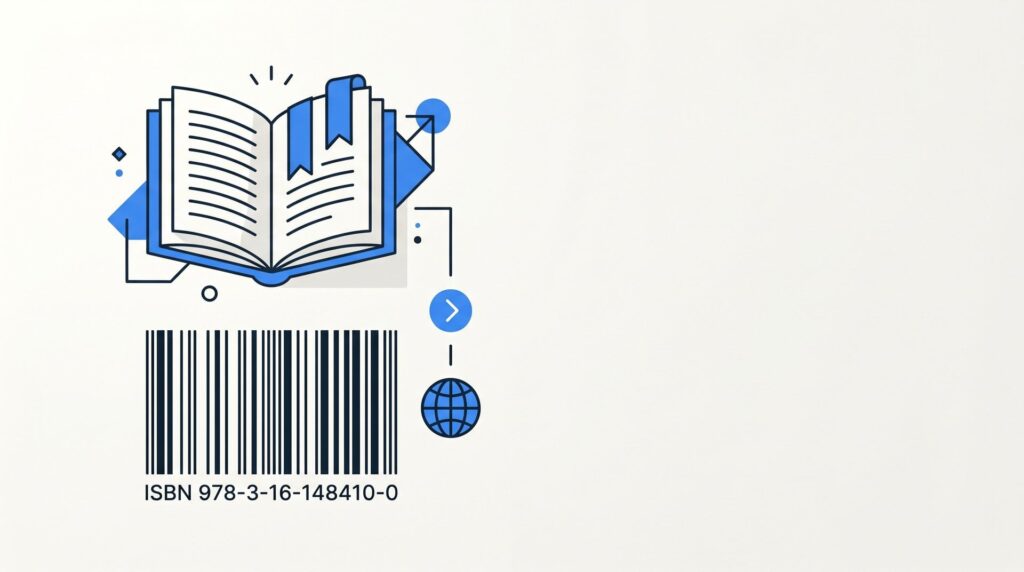
An EAN barcode is the scannable graphic that encodes a book’s ISBN for point-of-sale use. For a 13-digit book ISBN, the barcode is commonly displayed as an EAN-13 graphic. Retail staff can scan the code rather than manually entering the number, which supports faster and more reliable sales processing.
Do not treat the barcode as a decorative rectangle added at the last minute. A low-resolution image, incorrect sizing, poor contrast, or placement too close to a cover edge can make scanning unreliable. A high-resolution barcode file gives your cover designer and printer a clean asset to place in the barcode area.
GS1, the standards organization associated with barcode systems, emphasizes print quality and proper symbol reproduction for dependable scanning. Your printer may provide a cover template with a designated barcode location. Follow that template, but confirm that the number encoded in the barcode matches the ISBN assigned to that exact print format.
A practical review before you approve the proof
Before ordering an author copy or activating distribution, compare the information on your cover, copyright page, ISBN registration, barcode file, and printer dashboard. These records should agree. A paperback ISBN should not appear on a hardcover cover, and an ebook ISBN should not be used on a print edition simply because the title is the same.
Check the physical proof for trim size, spine text, margins, image resolution, and barcode placement. Then check the business side: publisher name, publication date, price, sales territories, return settings if offered, and distribution channels. A proof catches production issues; a metadata review catches market-facing issues. You need both.
For authors planning a multi-format release, establish the identifier plan early. Assign the correct ISBN to each format, keep a simple record of each assignment, and avoid reusing a number for a different edition. ISBN US can help authors and small publishers receive an ISBN and high-resolution EAN barcode package quickly while keeping title details organized for publication.
Frequently Asked Questions
Should I get an ISBN from my print on demand provider?
Choose an ISBN from an authorized agent for the US ISBN Agency when your print on demand book needs credible ownership, accurate publisher identification, and broad retail distribution. A printer’s free number may support production, but it can place the printer or a publishing company in the publisher record instead.
A provider-issued number is not automatically wrong, but it may limit your flexibility. Read the provider terms and confirm who is listed as publisher, whether the ISBN can be used elsewhere, and whether your book is being registered under your own name or imprint. Authors building a lasting catalog usually benefit from direct control.
Does each print on demand format need a different ISBN?
Use a separate ISBN for each format that is materially different, including paperback, hardcover, EPUB ebook, audiobook, and revised edition. Print on demand changes the manufacturing method, not the ISBN rule. One paperback sold through a printer, your website, and retailers normally keeps the same registered ISBN across those channels.
A new cover alone may not always require a new ISBN, but a new edition with meaningful changes often does. When in doubt, review the format and edition rules before uploading files. Proper assignment prevents retailer confusion and keeps your catalog organized as your publishing business grows.
What is the difference between an ISBN and an EAN barcode?
An EAN barcode is the scannable graphic that carries a book’s 13-digit ISBN for point-of-sale systems. A high-resolution file helps printers reproduce clean bars and helps retailers scan reliably. The barcode does not replace registration: title, contributor, format, price, and publisher metadata must also be accurate before retail distribution begins.
Think of the ISBN as the publication identifier and the EAN barcode as the machine-readable version used at checkout. The barcode must encode the ISBN for the specific format. Always verify the number before finalizing the cover, especially when you are producing more than one edition.
A careful setup gives your book more than a way to be printed. It gives readers, retailers, and distributors a clear record of what the book is, who published it, and how to sell it with confidence.